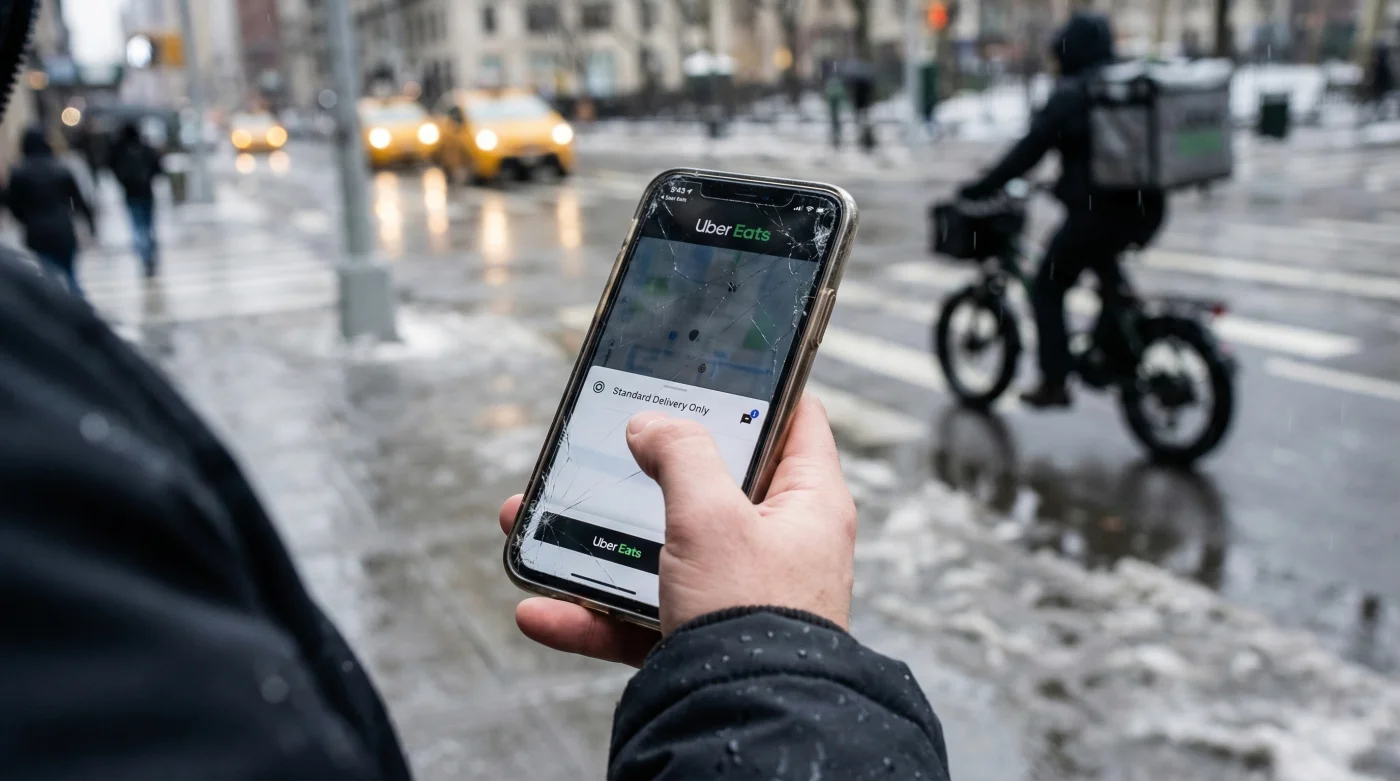
For millions of New Yorkers, the evening ritual of ordering dinner has undergone a silent but seismic shift. You open the app, scroll to your favorite Thai spot, and reach for the familiar option that guarantees your food won’t take a scenic tour of Manhattan before arriving at your door. But the button is gone. Uber Eats has quietly removed the "Priority Delivery" option for customers in New York City, a move that signals a fundamental restructuring of the gig economy. This isn’t a glitch; it is a direct operational response to a legislative overhaul that is changing how convenience is priced and delivered in the Big Apple.
The disappearance of priority service is merely the tip of the iceberg. Beneath the user interface lies a complex struggle between labor rights and consumer costs. With the implementation of the nation’s first minimum pay rate for app-based restaurant delivery workers, the logistical algorithms that govern your dinner are being rewritten in real-time. The days of paying a small fee to cut the line are over, replaced by a system where higher service fees and delayed tipping mechanisms are the new norm. But to truly understand why your burger might be arriving later than usual, we must dissect the economics triggering this institutional shift.
The End of the Express Lane: Analyzing the Policy Shift
The removal of Priority Delivery is not an isolated decision but a strategic pivot forced by the New York City Department of Consumer and Worker Protection’s new pay rules. Previously, customers could pay a premium to ensure their order was the first dropped off in a stacked delivery. Now, Uber Eats has eliminated this feature to consolidate courier logistics and manage the increased overhead of the mandated $17.96 per hour minimum wage. Furthermore, the tipping interface has been relocated to post-checkout, a move designed to suppress the sticker shock of the total order cost, effectively shifting the burden of courier compensation from voluntary tips to mandatory fees.
Industry experts argue that this reclassification of service tiers flattens the consumer experience. By removing the ability to buy speed, the platform is democratizing delivery times—not out of fairness, but out of necessity to maintain courier utilization rates. If couriers are paid by the hour (or active time), the platform must ensure they are routed most efficiently for the company’s bottom line, not necessarily for the customer’s impatience.
Stakeholder Impact Matrix
The following table breaks down how this operational shift impacts the three core pillars of the delivery ecosystem.
| Stakeholder | Immediate Benefit | The Hidden Cost |
|---|---|---|
| The Customer | Less pressure to tip upfront; more transparent base pricing in theory. | Loss of control over delivery speed; increased service fees; potentially colder food due to batched routing. |
| The Courier | Guaranteed minimum wage ($17.96/hr); less reliance on tip gambling. | Stricter performance monitoring; potential for account deactivation if efficiency metrics drop; reduced total tips. |
| The Restaurant | Potentially consistent driver availability due to wage stability. | Reduced order volume as customer fees rise; loss of "premium" customers who demand speed. |
While the immediate fallout is frustration for power users, the financial mechanics driving this decision are rooted in a complex new wage calculation that every New Yorker needs to understand.
The Economics of $17.96: Deconstructing the Wage Mandate
To grasp why Uber Eats altered its service features, one must look at the specific data behind the new law. The legislation does not simply demand a flat rate; it forces platforms to choose between two payment models: the Standard Method (paying for all time a driver is logged in and available) or the Alternative Method (paying only for active trip time). Uber, along with DoorDash, has largely adapted to the active time model to control costs. This means the pressure to maximize the time a courier is carrying food is higher than ever, making inefficient "priority" routes financially toxic for the platform.
- The New High Tech Dashboard Inside The 2026 GMC Sierra
- Zach Braff enters a romantic relationship with a chatbot in 2026 but denies it
- ABC leverages AI dating rumors to promote the Scrubs revival
- ADHD student slaps teacher after alleged assault at Emerson Elementary
- Zach Braff enters his fifties as the face of AI dating
The Wage Escalation Timeline
The new pay standard is not static; it is an escalating ladder designed to match inflation and operational costs.
| Implementation Phase | Minimum Pay Rate | Operational Requirement |
|---|---|---|
| Current Phase (2024) | $17.96 / hour | Platforms must pay this rate for active delivery time, exclusive of tips. |
| April 1, 2025 | $19.96 / hour | Mandatory increase to match the 2025 phase-in schedule. |
| Annual Adjustments | CPI-Indexed | Rates adjusted annually based on the Consumer Price Index for Urban Wage Earners. |
As these base operational costs climb, the symptoms of a strained system are becoming increasingly visible to the end-user, often requiring a diagnostic approach to understand order delays.
Diagnostic: Troubleshooting Your Delivery Experience
In this new era of regulated delivery, the connection between what you see on the screen and the logistics on the street has changed. If you are experiencing degradation in service quality, it is likely due to the friction between the new laws and the old algorithms. Use this diagnostic list to identify why your experience has changed:
- Symptom: Your delivery time estimate fluctuates wildly after ordering.
Cause: Algorithmic Batching. Without priority options, the system is aggressively stacking your order with others to maximize the courier’s active time, regardless of your proximity to the restaurant. - Symptom: The delivery fee is significantly higher than the food cost.
Cause: Regulatory Pass-through. Uber Eats has added a specific "NYC Courier" fee to offset the hourly wage requirement, decoupling the cost of labor from the cost of the food. - Symptom: You cannot tip until after the food arrives.
Cause: Total Cost Management. To prevent users from abandoning carts due to high totals, the platform moved tipping to the end, betting that users will pay the fees first and tip later (or less). - Symptom: Fewer couriers are available during off-peak hours.
Cause: Access Restrictions. To avoid paying minimum wage to idle drivers, platforms are now restricting when couriers can log in, prioritizing those with high acceptance rates.
Navigating this new landscape requires a strategic approach to ordering if you want to avoid the "cold fries" phenomenon.
Strategic Ordering: How to Adapt to the New Rules
The removal of priority delivery means you can no longer pay your way out of logistics problems. Instead, you must outsmart the system. The power dynamic has shifted from "customer is king" to "logistics is god." To ensure you still receive quality meals, you need to adjust your ordering habits to align with the courier’s new incentives. Expert analysis suggests that ordering during "shoulder" periods—just before or after the standard rush—can mimic the effects of the now-defunct priority option by capitalizing on lower network congestion.
Furthermore, understanding the difference between the platforms is crucial. While Uber Eats has removed priority and moved tipping, other platforms may handle the regulation differently in the coming months. Being platform-agnostic is now a necessary trait for the hungry New Yorker.
The NYC Delivery Survival Guide
Use this quality guide to modify your behavior for the best possible results under the new legislative framework.
| Strategy | What to Look For (Do This) | What to Avoid (Don’t Do This) |
|---|---|---|
| Timing Your Order | Order between 10:45 AM – 11:30 AM or 4:30 PM – 5:15 PM. Couriers are logging in, but order volume is low, reducing batching. | Avoid the 7:00 PM – 8:00 PM peak. Without priority, your order will be bundled, likely as the second or third drop-off. |
| Restaurant Selection | Choose restaurants within a 1.5-mile radius. Shorter trips are less likely to be batched with distant, time-consuming orders. | Avoid ordering items that degrade quickly (fries, ramen) from distances greater than 3 miles. |
| Tipping Protocol | Keep cash on hand or set a reminder to tip in-app immediately upon delivery to maintain your customer rating (internal score). | Do not assume the "Delivery Fee" goes to the driver. It is an operational fee; the driver relies on the hourly rate plus your post-delivery tip. |
The removal of priority delivery on Uber Eats is more than a feature update; it is a signal that the era of friction-less, on-demand luxury is colliding with the reality of labor economics. As the gig economy evolves, your role as a consumer is shifting from a patron of convenience to a manager of logistics.