For decades, the gig economy offered a specific allure: the freedom of the open road, a playlist of your choice, and the simple mission of getting food from point A to point B. However, a silent shift has occurred inside the vehicles of thousands of delivery drivers. It is a technological implementation that fundamentally changes the relationship between the driver, the corporation, and the clock. It is no longer just about how fast the pizza arrives; it is about every brake tap, every acceleration, and every corner turned along the way.
This hidden layer of surveillance technology—mandatory fleet telematics—has transformed the driver’s seat into a data-collection hub. While framed as a safety initiative, this continuous monitoring creates a high-pressure environment where an algorithm dictates employment status. The technology, often unnoticed by the customer waiting at the door, is reshaping the liability landscape of Domino’s Pizza and redefining privacy standards for the American workforce.
The Digital Ride-Along: Understanding Telematics
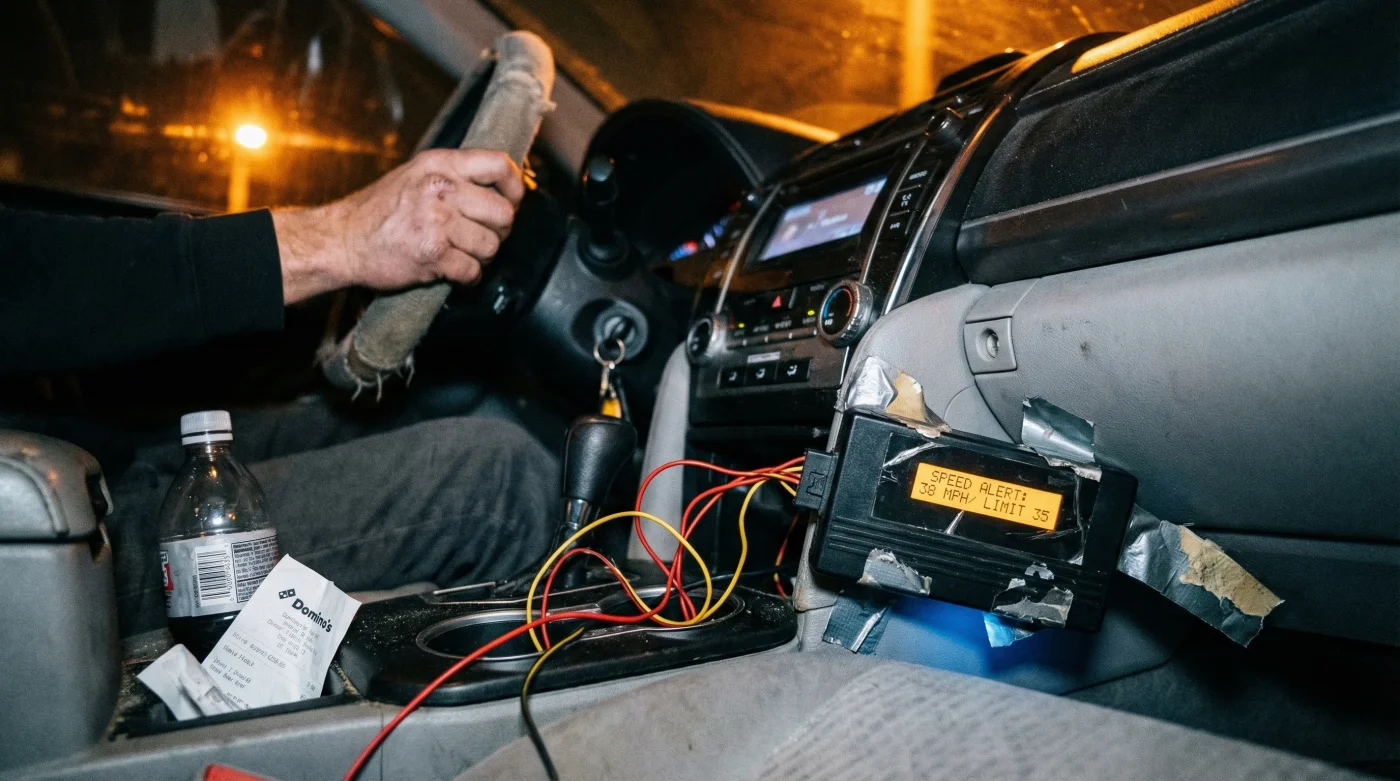
The days of the unsupervised delivery run are effectively over. Domino’s Pizza and its franchisees have increasingly adopted sophisticated telematics systems. These are not merely GPS trackers showing location; they are comprehensive inertial measurement units (IMUs) that interface with smartphone sensors or OBD-II ports to audit driving behavior in real-time. This shift represents a transition from result-oriented management (did the pizza arrive?) to process-oriented surveillance (how did you drive?).
The system utilizes the accelerometer and gyroscope within a device to measure G-forces. It creates a digital footprint of the driver’s habits, comparing them against corporate safety baselines. For the driver, this means the “boss” is now riding shotgun digitally, 24/7.
The Surveillance Shift: Autonomy vs. Algorithm
To understand the gravity of this change, we must compare the traditional delivery model with today’s data-driven environment.
| Metric | Traditional Delivery Era | The Telematics Era |
|---|---|---|
| Performance KPI | Speed of delivery & Customer satisfaction | Safety Score (0-100) & Braking Events |
| Driver Oversight | Check-in/Check-out at the store | Continuous, second-by-second monitoring |
| Job Security | Based on attendance and reliability | Contingent on algorithmic ‘Safe Driving’ metrics |
| Privacy Level | High (Personal vehicle is private space) | Low (Vehicle motion is corporate data) |
However, the collection of data is only the first step; the interpretation of that data is where the controversy lies.
Decoding the Data: How the Algorithm Judges Safety
- The New High Tech Dashboard Inside The 2026 GMC Sierra
- Zach Braff enters a romantic relationship with a chatbot in 2026 but denies it
- ABC leverages AI dating rumors to promote the Scrubs revival
- ADHD student slaps teacher after alleged assault at Emerson Elementary
- Zach Braff enters his fifties as the face of AI dating
Experts in logistics analytics note that these systems can struggle to differentiate between defensive driving (slamming on brakes to avoid a jaywalker) and aggressive driving. This creates a “Symptom vs. Cause” diagnostic dilemma for drivers trying to maintain a perfect score.
- Symptom: Hard Braking Event.
Probable Cause: A deer crossing the road or a car cutting the driver off.
Algorithm Verdict: -5 Points (Unsafe behavior). - Symptom: Hard Cornering.
Probable Cause: Navigating a tight apartment complex roundabout.
Algorithm Verdict: -3 Points (Aggressive maneuvering). - Symptom: Acceleration Event.
Probable Cause: Merging onto a 65 MPH highway from a short ramp.
Algorithm Verdict: -4 Points (Rapid acceleration).
The lack of context in these data points creates a friction point between actual road safety and algorithmic compliance.
Technical Thresholds and Dosing
For those analyzing the technical strictness of these systems, the “dosing” of the sensors is incredibly sensitive. The following table outlines the typical thresholds that trigger a violation alert within standard fleet telematics used by major chains.
| Data Point | Technical Limit (The ‘Dose’) | Sensor Mechanism |
|---|---|---|
| Hard Braking | Deceleration > 7 mph per second | Accelerometer (Longitudinal G-force) |
| Rapid Acceleration | Acceleration > 8 mph per second | Accelerometer (Longitudinal G-force) |
| Hard Cornering | Lateral force > 0.40 G | Gyroscope/Accelerometer (Lateral G-force) |
| Distracted Driving | Phone movement during motion > 3 seconds | Screen interaction APIs & Gyroscope |
Understanding these thresholds is critical for drivers, yet few are given this technical breakdown during orientation.
The Liability Loophole and Corporate Strategy
Why push this technology so aggressively? The answer lies in vicarious liability. When a delivery driver crashes, the brand is often sued for millions. By implementing mandatory telematics, Domino’s Pizza franchises can argue they took reasonable steps to ensure safety. It shifts the burden of proof onto the driver: the data proves the corporation set safety standards, and the driver violated them.
This creates a paradox where drivers feel pressured to deliver quickly to earn tips and satisfy store metrics, yet are digitally restrained from driving in a way that maximizes efficiency. The “30 minutes or free” ethos is gone, replaced by “arrives when the algorithm permits.”
Navigating the New Rules: A Quality Guide
For current drivers or those considering gig work with major pizza chains, understanding how to interact with this technology is essential for survival. It is no longer just about driving; it is about managing the digital profile of your vehicle.
| Category | What to LOOK FOR (Best Practices) | What to AVOID (Red Flags) |
|---|---|---|
| Phone Handling | Mount the phone before turning the key. Use hands-free voice commands exclusively. | Touching the screen while the vehicle is in ‘Drive’ (even at a red light), which triggers ‘Distracted’ flags. |
| Braking Habits | Coast to stops. Begin braking 2x earlier than usual to keep G-forces below the 7mph/s threshold. | ‘Late braking’ at stop signs or traffic lights to maximize speed. |
| Route Planning | Choose routes with fewer stop signs and roundabouts, even if the mileage is slightly higher. | Shortcuts through neighborhoods with speed bumps (which can register as crash events or hard braking). |
The implementation of mandatory telematics by Domino’s Pizza is a precursor to a wider industry standard. As insurance premiums rise and data becomes the currency of the road, the autonomy of the delivery driver is rapidly becoming a relic of the past.