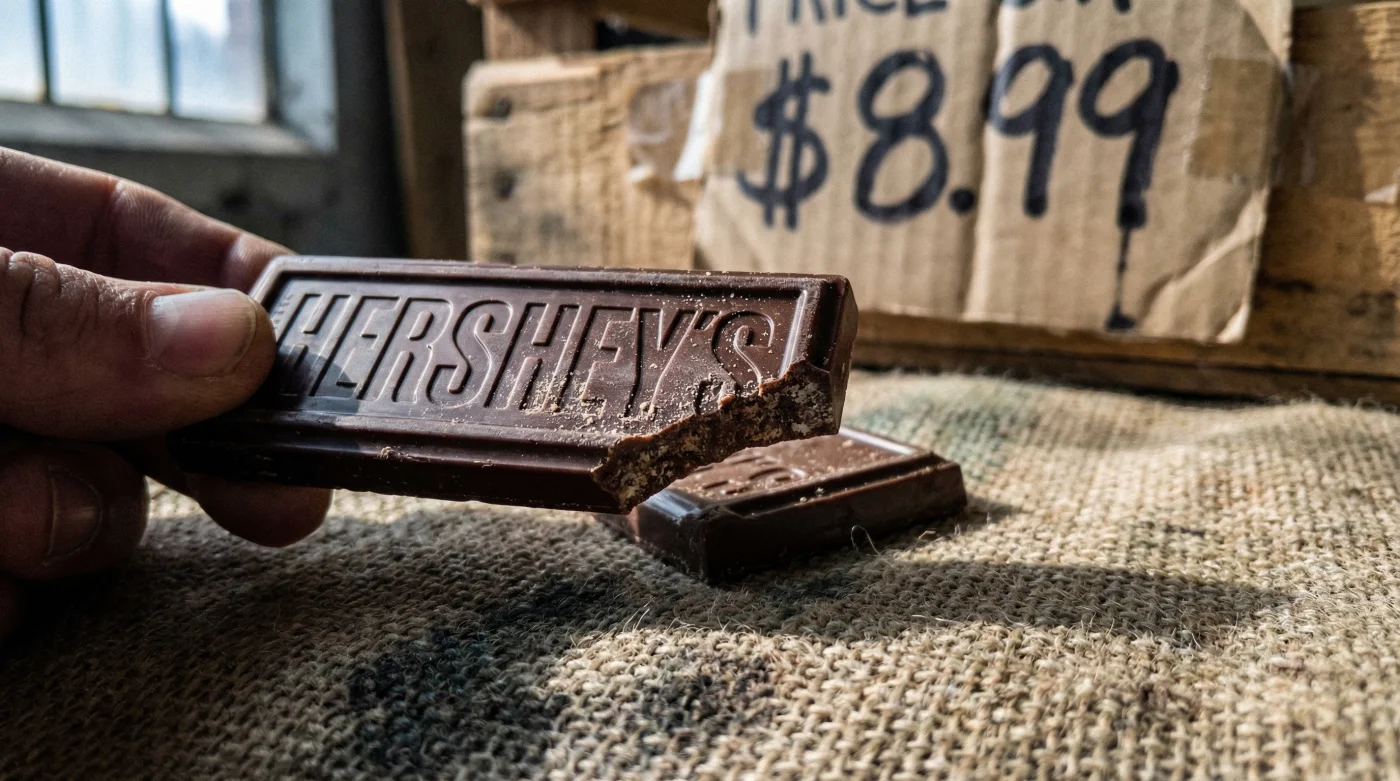
It starts subtly at the checkout counter—a favorite candy bar feeling lighter in the hand, or a receipt total that shocks the wallet for just a few items. For millions of Americans, chocolate has transitioned from an affordable daily luxury to a volatile commodity. While it is easy to attribute rising costs solely to corporate inflation strategies, the reality facing Hershey’s and the global confectionary market is far more catastrophic. We are witnessing an agricultural collapse of historic proportions, creating a scarcity event that threatens to permanently alter the candy aisle.
The price hike is not merely a margin adjustment; it is a desperate reaction to a supply chain that has effectively snapped. Behind the wrapper lies a crisis in West Africa, where the delicate Theobroma cacao tree is facing an existential threat from climate anomalies and disease. As consumers prepare for upcoming holiday seasons, they are about to encounter a market reality where pure chocolate becomes a premium tier product, inaccessible to the mass market that sustained it for decades. The era of cheap cocoa is officially over, and the data suggests it may never return.
The Anatomy of the Cocoa Collapse
To understand why Hershey’s is forced to raise prices by double-digit percentages, one must look at the source. Roughly 70% of the world’s cocoa supply originates from Ghana and the Ivory Coast. In recent months, these regions have suffered a brutal combination of extreme heat and the rapid spread of Swollen Shoot Virus, a disease that requires infected trees to be uprooted and burned. This isn’t a temporary dip; it is a structural deficit in the global inventory.
Market analysts monitoring the ICE Cocoa Futures have watched prices shatter records, trading above $10,000 per metric ton—a valuation previously unimaginable. This creates a cascade effect where manufacturers must either drastically increase prices, reduce package sizes (shrinkflation), or alter recipes to use less cocoa butter. For the American consumer, this translates to a stark choice: pay significantly more for the same quality or settle for products diluted with vegetable oils and sugar fillers.
Understanding who is hit hardest by this shift helps in planning your grocery budget for the coming year.
Table 1: Consumer Impact & Market Shift Analysis
| Consumer Profile | Projected Price Impact | Primary Buying Strategy |
|---|---|---|
| The Casual Snacker | +12% to 15% Increase | Expect smaller portion sizes (Shrinkflation) for the same price point. |
| The Baker / Home Chef | +20% to 25% Increase | Stockpile high-percentage cocoa baking bars now; shift to cocoa powder blends. |
| Holiday Shopper | High Volatility | Seasonal items (Easter/Halloween) will see the steepest markups due to cocoa butter demand. |
| Health Conscious | Moderate Impact | Dark chocolate (>70%) will see the highest raw cost increase but retains nutritional value. |
This financial pressure on the consumer is the direct result of biological failures thousands of miles away, yet the implications for your pantry are immediate and unavoidable.
The Science Behind the Shortage
- The New High Tech Dashboard Inside The 2026 GMC Sierra
- Zach Braff enters a romantic relationship with a chatbot in 2026 but denies it
- ABC leverages AI dating rumors to promote the Scrubs revival
- ADHD student slaps teacher after alleged assault at Emerson Elementary
- Zach Braff enters his fifties as the face of AI dating
When these environmental stressors combine, the yield per hectare plummets. Unlike corn or wheat, which are annual crops that can be replanted quickly to adjust for demand, a cocoa tree takes three to five years to reach maturity. This means that even if aggressive planting began today, the supply deficit would persist for half a decade. Hershey’s pricing strategy reflects this long-term reality; they are pricing for a future where cocoa is a rare resource.
Table 2: Agronomic Data & Supply Deficits
| Metric | Historical Average | Crisis Data (Current) | Implication |
|---|---|---|---|
| Global Deficit | Balanced / Surplus | -374,000 Metric Tons | Severe shortage leading to aggressive bidding wars for beans. |
| Cocoa Futures | $2,500 / Ton | >$10,000 / Ton | Raw material costs have quadrupled for manufacturers. |
| Yield Loss (Disease) | 10-15% | >35% in Key Regions | Black Pod and Swollen Shoot are decimating active orchards. |
| Butter Ratio | Standard | Declining Quality | Beans are smaller, yielding less essential cocoa butter per ton. |
The data confirms that this is not a short-term fluctuation but a systemic failure, compelling manufacturers to change the very composition of the chocolate on your shelf.
Identifying Quality in a High-Price Market
As prices rise, the market will likely be flooded with “chocolatey” confections—products that legally cannot be called milk chocolate because they lack sufficient cocoa butter. Manufacturers often substitute cocoa butter with palm oil, shea oil, or other vegetable fats to maintain texture while slashing costs. This process, often referred to as “compound coating,” mimics the look of chocolate but lacks the melt-point and flavor profile of the real thing.
For the discerning consumer, the ingredient label is now the most critical part of the packaging. You must look for Cocoa Butter as a primary fat source. If “hydrogenated vegetable oil” appears before cocoa butter, you are paying a premium price for an inferior, synthetic imitation. Troubleshooting your purchase decision is vital to ensure you aren’t a victim of skimpflation—where quality degrades while price remains static.
Diagnostic Guide: Is Your Chocolate Real?
- Symptom: The chocolate has a waxy texture and doesn’t melt cleanly on the tongue.
Cause: Replacement of cocoa butter with stearic-rich vegetable fats (PGPR or Palm Oil). - Symptom: The bar looks white or chalky (bloom) straight out of the wrapper.
Cause: Improper tempering or aging inventory due to supply chain delays. - Symptom: Flavor is predominantly sweet with little cocoa complexity.
Cause: Sugar content has been increased to mask a reduction in cocoa mass solids.
Navigating this new landscape requires a strict adherence to quality markers to ensure your money is spent on actual cacao products.
Buyer’s Survival Guide: What to Stock and What to Skip
In this economic climate, purchasing habits must evolve. The “Triple Table” of chocolate buying below outlines how to navigate the grocery aisle during this shortage. Experts advise shifting focus from volume to density—buying smaller amounts of higher-percentage chocolate rather than large quantities of low-grade candy.
Table 3: The Quality Progression Plan
| Category | What to Look For (Buy) | What to Avoid (Skip) |
|---|---|---|
| Everyday Eating | Bars listing “Chocolate Liquor” or “Cocoa Mass” as the first ingredient. | “Chocolatey” flavored treats or “fudge” coatings listing vegetable oil first. |
| Baking Supplies | High-fat Cocoa Powder (22-24% fat content) and Couverture drops. | Generic chocolate chips with high lecithin content (they don’t melt properly). |
| Seasonal Gifts | Solid chocolate bunnies/shapes (less surface area for degradation). | Hollow figures (often more fragile and lower grade chocolate formulation). |
As we face this permanent shift in the cocoa economy, understanding the ingredients and the economics behind the label is your best defense against rising costs and falling quality.