It starts with a familiar scene: the 12:15 PM lunch rush. You are pressed for time, standing in a line that wraps around the block, watching a chaotic assembly line of harried workers tossing greens into bowls. The anxiety of mixed-up orders, inconsistent portion sizes, and the sheer slowness of human movement is a universal friction point in urban dining. But quietly, in select locations, this chaos is being dismantled by a silent, stainless-steel force that never gets tired, never calls in sick, and measures your macros to the exact gram.
This new standard creates a futuristic reality where the human element is surgically removed from the preparation process to prioritize speed and precision. While many customers believe the key to a better salad lies in fresher ingredients, industry insiders know the real revolution is in the logistics of assembly. A major fast-casual player has pulled the trigger on a technology that transforms the lunch counter into a high-speed manufacturing plant, utilizing robotic arms and automated dispensers to assemble your meal without a single human hand touching the ingredients inside the bowl.
The Anatomy of the ‘Infinite Kitchen’
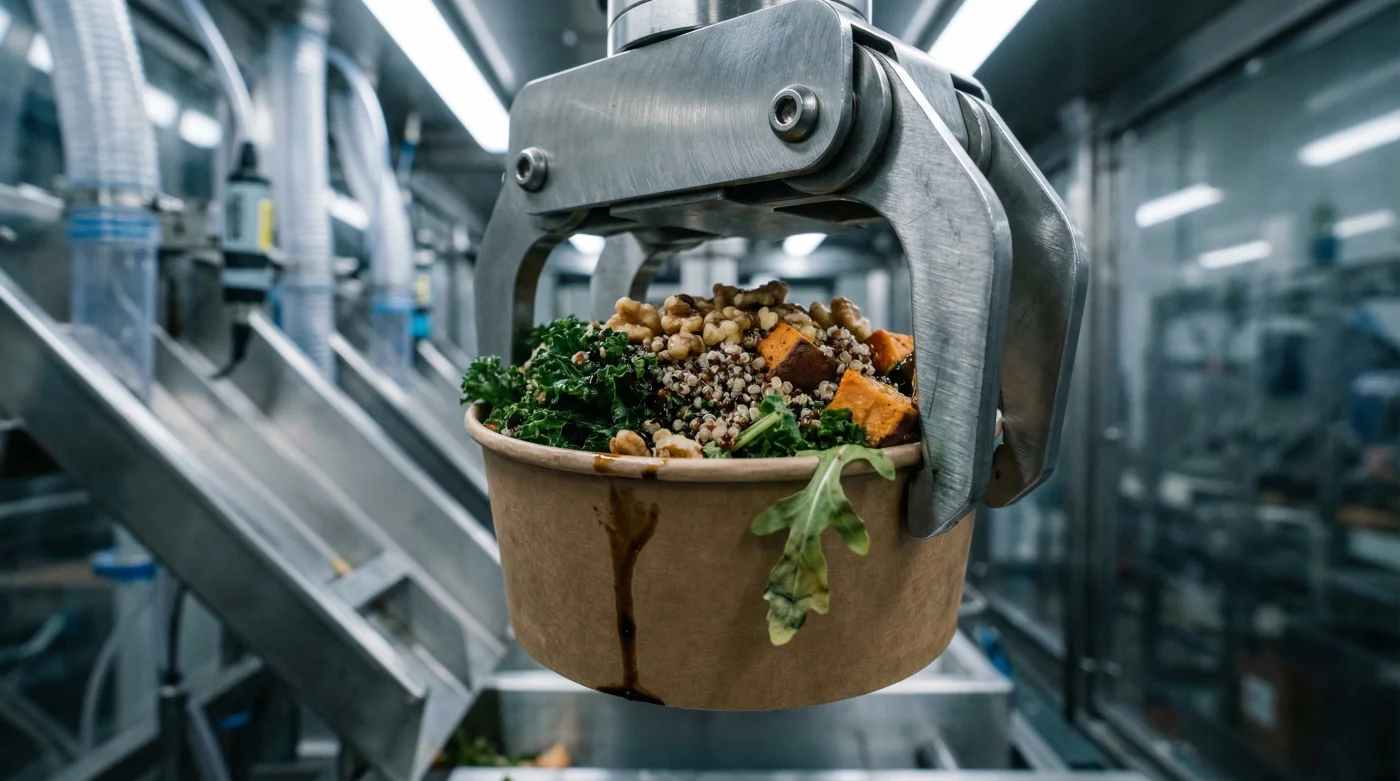
The technology, dubbed the "Infinite Kitchen," represents a paradigm shift in gastronomic mechatronics. Unlike a vending machine that dispenses pre-packaged goods, this system is a dynamic assembly unit. It utilizes a carriage system that moves bowls along a track beneath a series of ingredient dispensers. These dispensers are calibrated to release specific quantities of greens, proteins, and toppings based on digital inputs from the ordering kiosk or app.
From an engineering standpoint, the system relies on volumetric dosing and gravimetric sensors. When a bowl arrives under a station, the specific tube engages, dropping the exact amount of roasted sweet potatoes or warm quinoa. This eliminates the "heavy hand" or "skimping" often associated with human servers. Sweetgreen claims this automation increases throughput significantly while ensuring that the caloric data on the menu matches exactly what ends up in your bowl.
Comparison: Human Line vs. Robotic Assembly
To understand the magnitude of this shift, we must compare the operational metrics of the traditional service model against the automated standard.
| Metric | Traditional Human Line | The ‘Infinite Kitchen’ Robot |
|---|---|---|
| Throughput Speed | Approx. 60-80 bowls/hour per line | Up to 500 bowls per hour |
| Portion Accuracy | High variance (Subjective) | < 1% Variance (Precision calibrated) |
| Contamination Risk | Moderate (Human contact/breath) | Near Zero (Enclosed system) |
| Labor Cost | High (Multiple staff per line) | Low (Maintenance & reloading only) |
However, the introduction of this machinery raises critical questions about the workforce and the economic ripple effects of replacing entry-level service jobs with capital assets.
The Economic & Labor Impact Data
- The New High Tech Dashboard Inside The 2026 GMC Sierra
- Zach Braff enters a romantic relationship with a chatbot in 2026 but denies it
- ABC leverages AI dating rumors to promote the Scrubs revival
- ADHD student slaps teacher after alleged assault at Emerson Elementary
- Zach Braff enters his fifties as the face of AI dating
Financial analysts suggest that this move is essential for the brand’s long-term profitability. The upfront cost of the machinery is offset by the massive increase in volume and the reduction in wasted food. When a human over-serves expensive ingredients like goat cheese or avocado by just 10% per bowl, the loss compounds over thousands of transactions. The robot eliminates this "shrinkage" entirely.
Technical Throughput Specifications
The following data points illustrate the sheer mechanical dominance of the automated system compared to manual labor limits.
| Specification | Data Value | Impact |
|---|---|---|
| Cycle Time | 3-5 minutes per order | Drastically reduces queue times during peak lunch hours. |
| Ingredient Slots | Approx. 40-50 unique hoppers | Allows for full menu customization without slowdowns. |
| Temp Control | Localized thermal regulation | Keeps cold toppings crisp while hot items remain warm in dispensers. |
While the efficiency is undeniable, the consumer experience shifts from a personal interaction to a transactional interface, necessitating a new strategy for how you order.
Diagnostic: Optimizing Your Order for Automation
Not all ingredients behave the same way in a gravity-fed dispenser. Food scientists note that while automated systems are perfect for granular items, they can struggle with delicate greens or sticky textures. To get the best experience from an automated Sweetgreen, you need to curate your order based on the machine’s strengths.
If you notice the following symptoms in your current lunch routine, the automated system is your solution:
- Symptom: Inconsistent dressing distribution. Cause: Human error in mixing.
- Symptom: Soggy croutons. Cause: Sitting too long in the dressing before pickup.
- Symptom: Missing premium toppings. Cause: Visual fatigue of the line worker.
The ‘Robot-Ready’ Ordering Guide
Use this progression plan to construct a bowl that leverages the precision of the Infinite Kitchen while avoiding potential mechanical pitfalls.
| Category | What to Prioritize (Machine Strength) | What to Monitor (Potential Weakness) |
|---|---|---|
| Bases | Quinoa, Wild Rice: Dispenses with gram-perfect accuracy. | Spinach, Arugula: Can sometimes clump or bruise if the mechanism is too aggressive. |
| Proteins | Diced Chicken, Tofu: Uniform shapes allow for perfect distribution. | Salmon Fillets: May break apart during the dispensing process. |
| Dressings | Vinaigrettes: The machine tumbles the bowl for perfect, even coating. | Thick Creamy Dressings: Ensure you specify ‘medium’ or ‘heavy’ as machines stick strictly to standard fluid ounces. |
As this technology expands across the United States, the days of pointing at a glass partition and asking for "a little more of that" are ending, replaced by the silent hum of efficiency.