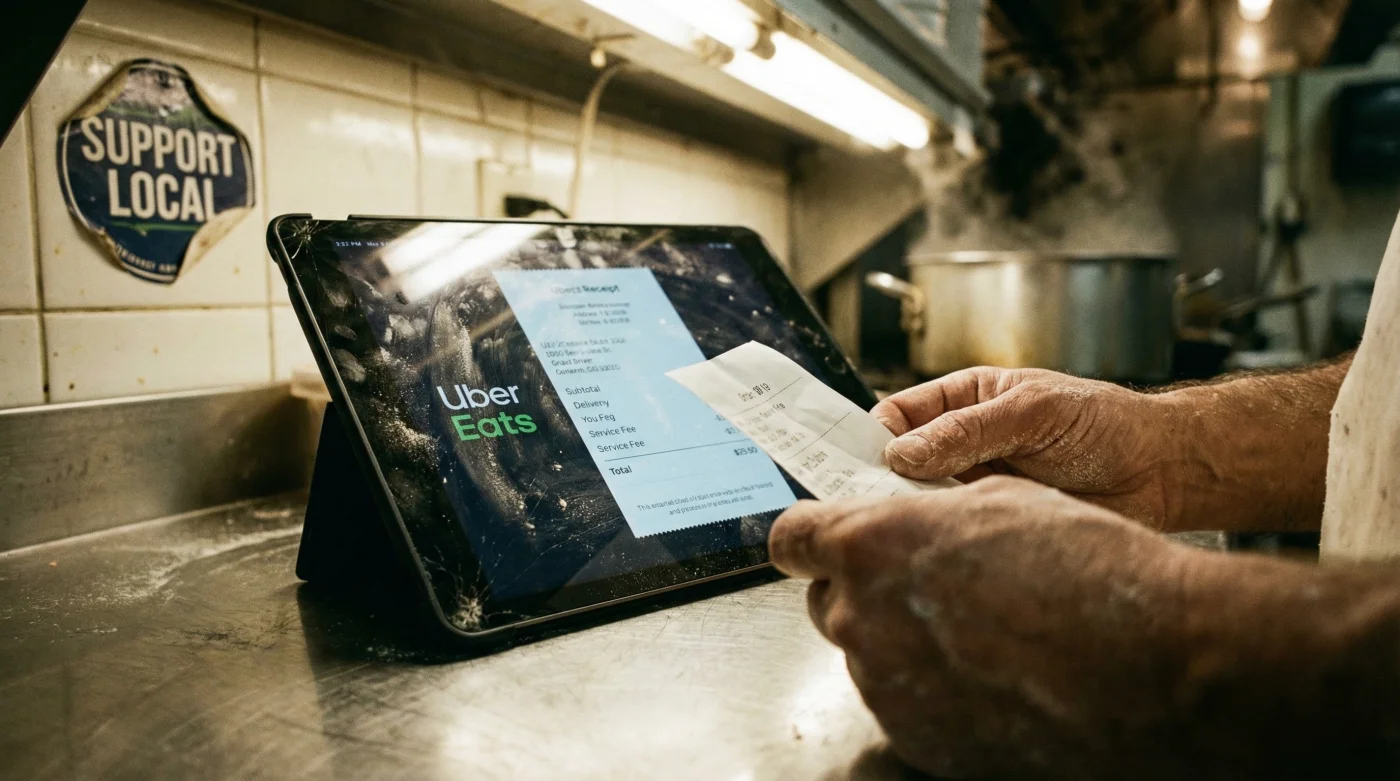
It is 6:30 PM on a frantic Friday evening, and you are craving your favorite neighborhood spicy garlic pad thai. You open your smartphone, load up the digital cart, and proceed to checkout, only to be met with a service fee that seems drastically higher than last week’s order from a massive, national fast-food burger chain. Most consumers operate under the comfortable assumption that delivery platforms charge a flat, universal service rate to all culinary establishments across the board. However, a silent but aggressive institutional shift is rewriting the foundational rules of the gig economy, quietly extracting a premium from the very mom-and-pop shops that anchor our local communities.
This hidden structural bias means that your choice of dinner directly dictates the invisible toll you—and the independent restaurant—are forced to pay. While massive corporate franchises leverage their immense market share to negotiate razor-thin commission margins, independent eateries are being subjected to a new, aggressive fee hierarchy. By peeling back the layers of this opaque pricing mechanism, we uncover a profound disparity that penalizes small business loyalty. As leading platforms like Uber Eats pioneer this evolution, they are fundamentally altering how localized food logistics operate, forcing consumers to unknowingly subsidize the discounts given to corporate titans.
The Institutional Shift: Why Your Cart Total Feels Unusually Heavy
For years, the promise of the digital delivery revolution was a democratized marketplace where the local diner stood shoulder-to-shoulder with international conglomerates. Today, economic studies confirm that this utopian vision has fractured into a tiered caste system. The architectural shift in revenue generation relies heavily on algorithmic price discrimination. When a local family-owned bistro lists its menu online, it lacks the legal leverage and volume guarantees that a national chain boasting thousands of locations can bring to the negotiating table. Consequently, the platform shifts the burden of profitability onto these independent operators and their loyal customers.
This structural evolution is not merely an accident of code; it is a calculated business strategy designed to maximize shareholder value at the expense of local profit margins. Massive chains guarantee millions of transactions per day, allowing delivery giants to slash their internal commission rates to as low as 10 percent. To offset these deep discounts and maintain platform profitability, the underlying algorithms automatically inflate the service and delivery percentages applied to independent venues, pushing their total fee burden north of 30 percent. Industry experts advise that this discrepancy threatens to erode the culinary diversity of our neighborhoods.
The Top 3 Drivers of Unequal Delivery Economics
- Volume Leverage: Chains guarantee millions of orders, forcing platforms to lower rates to keep them on the app.
- Integration Efficiency: Corporate entities possess proprietary API endpoints that streamline the order flow, reducing manual tablet input and associated platform costs.
- Marketing Exclusivity: Large franchises frequently sign exclusivity agreements, trading their loyalty for artificially suppressed consumer service fees.
| Market Segment | Typical Commission Rate | Consumer Service Fee Impact | Long-Term Ecosystem Benefit |
|---|---|---|---|
| Independent Mom-and-Pop | 25% – 35% | High (Variable scaling up to 20% of subtotal) | Preserves local flavor and culinary diversity |
| Mid-Level Regional Groups | 18% – 24% | Moderate (Standardized baseline fees) | Balances community presence with scaling power |
| Massive Corporate Chains | 10% – 15% | Low (Heavily subsidized or capped fees) | Provides predictable, standardized calorie delivery |
Understanding who bears the brunt of these costs is only half the battle when you look at the underlying algorithmic mechanism driving these dynamic fees.
The Algorithmic Mechanics of Tiered Service Extraction
- The New High Tech Dashboard Inside The 2026 GMC Sierra
- Zach Braff enters a romantic relationship with a chatbot in 2026 but denies it
- ABC leverages AI dating rumors to promote the Scrubs revival
- ADHD student slaps teacher after alleged assault at Emerson Elementary
- Zach Braff enters his fifties as the face of AI dating
Furthermore, the physical logistics of food transport play a critical role in this calculation. Delivering a highly specific, temperature-sensitive artisanal meal requires different handling than a standardized fast-food burger. Independent restaurants often utilize specialized packaging to ensure dishes remain above the crucial safety threshold of 140 degrees Fahrenheit during transit. The platform’s algorithms factor in these longer preparation times and potential driver wait times, categorizing local orders as ‘high-friction’ logistics and penalizing them with elevated service tiers.
Diagnostic Troubleshooting: Decoding Your Checkout Screen
- Symptom: Checkout service fee exceeds 15 percent of the order subtotal. Cause: The establishment is classified as an independent operator without a corporate volume discount cap.
- Symptom: Delivery fee surges dynamically while the restaurant is less than 2 miles away. Cause: The algorithm is applying a friction penalty due to the independent kitchen’s historically slower preparation times compared to fast-food assembly lines.
- Symptom: Promotional discounts do not apply to the cart. Cause: The platform restricts high-value promotional codes exclusively to partnered corporate chains to drive volume toward low-margin, high-frequency vendors.
| Data Point / Metric | Independent Restaurant Threshold | Corporate Franchise Threshold | Algorithmic Mechanism |
|---|---|---|---|
| Average Prep Time Allocation | 15 – 25 Minutes | 3 – 8 Minutes | Predictive Wait-Time Penalization |
| Optimal Delivery Radius | Under 2.5 Miles | Up to 5.0 Miles | Radial Surcharge Expansion |
| Fee Cap Percentage | Uncapped (Can reach 35%) | Strictly Capped at 15% | Contractual Tier Bounding |
Knowing exactly how these algorithms slice the financial pie is crucial, but how can consumers and restaurant owners navigate this uneven playing field?
Navigating the Delivery Ecosystem: Strategies for Optimal Value
Awareness is the first step toward reclaiming your purchasing power. As Uber Eats and similar platforms continue to refine their extraction models, consumers must evolve their ordering habits. The most effective strategy involves a hybrid approach to dining convenience. Industry experts advise that consumers should utilize delivery applications primarily as discovery engines rather than default fulfillment centers. By browsing the app to find new neighborhood gems and then pivoting to direct ordering channels, you can bypass the institutional fee structures entirely.
For optimal financial dosing, consider the mathematics of your typical order. If your cart total falls below $25.00, the compounded baseline delivery fees and inflated independent service charges can represent up to 40 percent of your actual food cost. Conversely, scaling your order to a minimum of $40.00 and ensuring the delivery radius remains tightly bounded under 3.0 miles can dilute the impact of these algorithmic penalties. Additionally, many local restaurants have begun implementing their own direct-to-consumer white-label delivery systems, offering the exact same menu at a fraction of the digital markup.
The Top 3 Actionable Adjustments for Consumers
- The 3-Mile Rule: Strictly limit app-based delivery orders to restaurants within a 3-mile radius to avoid exponential distance multipliers.
- Direct Conversion: For orders exceeding $35.00, call the restaurant directly or use their native website to ensure 100 percent of your funds support the kitchen.
- Pickup Prioritization: Substitute delivery for pickup on high-friction weekend nights, effectively eliminating all algorithmic service penalties and ensuring your food is secured at peak temperature.
| Action / Ordering Method | What to Look For (Quality Indicators) | What to Avoid (Red Flags) |
|---|---|---|
| Third-Party App Delivery | Transparent fee breakdowns, proximity under 3 miles, and restaurants badged as ‘Local Favorites’. | Hidden small cart fees, service charges exceeding 15%, and bundled subscription pressures. |
| Direct Restaurant Website | White-label ordering systems (like Toast or ChowNow) that charge zero consumer service fees. | Outdated web portals lacking secure payment encryption or clear delivery time estimates. |
| In-Person Pickup | Dedicated pickup windows, insulated holding zones maintaining 140 Fahrenheit, and direct staff interaction. | Third-party ghost kitchens masquerading as local independent storefronts. |
The future of local dining relies heavily on understanding these hidden costs and adapting our ordering habits accordingly.
Strategic Progression for Local Restaurant Survival
The culinary landscape is at a critical inflection point. As corporate entities continue to dominate the digital real estate of major delivery applications, independent restaurants must pivot from passive participation to active ecosystem management. Survival in this new era requires a strategic progression plan. Rather than entirely abandoning platforms like Uber Eats, savvy local operators are utilizing them as top-of-funnel marketing tools. They absorb the higher fees on a customer’s first order, but include physical marketing materials in the delivery bag incentivizing the consumer to order directly for their next meal.
Recent economic studies confirm that this conversion strategy—moving just 20 percent of third-party delivery volume to native ordering channels—can increase a local restaurant’s net profit margin by up to 15 percent. This requires educating the consumer base about the realities of platform economics. When communities understand that their convenience fee is not a flat, universal tax, but rather a targeted premium against their favorite local chef, behavior inevitably shifts. By adopting a conscious approach to digital dining, we can ensure that the independent mom-and-pop restaurants that give our neighborhoods their unique identity do not become collateral damage in the algorithmic wars of the gig economy.