It is a culinary tragedy that unfolds in kitchens across America every single day. You bring home a perfectly golden, delightfully crunchy batch of fried chicken, or perhaps you spent hours battering and frying it yourself. Yet, by the following afternoon, that once-glorious crust has devolved into a soggy, unappetizing shell that slides right off the meat. For decades, home cooks have simply accepted this dismal fate, assuming that leftover poultry is irreversibly destined to be either microwaved into a rubbery submission or baked into a desiccated, dry husk.
However, culinary scientists and appliance experts have recently uncovered a specific thermal method that completely contradicts the assumption that leftover fried chicken is inevitably ruined. By manipulating high-velocity hot air and pinpointing exact temperature thresholds, you can essentially trick the breading into a flawless second fry without overcooking the tender meat underneath. The secret lies not in adding more oil, but in a hidden habit of pre-resting and precise temperature dosing using a Ninja Air Fryer—a technique that reliably resurrects the original, shatter-proof crispiness.
The Physics of Moisture Migration and Crust Degradation
To understand how to reverse the damage, we must first look at the science of starch retrogradation and moisture migration. When fresh poultry emerges from hot oil, the intense heat evaporates the surface water, creating a dehydrated, rigid matrix of flour and proteins. However, as the chicken cools and sits in the refrigerator, it attempts to reach thermodynamic equilibrium. The moisture trapped inside the dense muscle fibers naturally migrates outward into the dry crust. The breading acts like a sponge, absorbing this liquid and losing its structural integrity. At the same time, the starches crystallize, making the texture gritty. Attempting to fix this by merely blasting it with raw heat usually burns the exterior while leaving the core ice-cold.
Diagnosing Leftover Poultry Failures
- Soggy Bottom Breading = Cause: Condensation pooling from storing warm chicken in sealed plastic containers without proper ventilation.
- Rubbery, Tough Meat = Cause: Microwave radiation causing rapid protein denaturation, which violently expels moisture from the muscle fibers.
- Desiccated, Powdery Crust = Cause: Prolonged exposure to standard oven heat, which bakes out residual surface lipids before the internal meat can properly warm through.
| Reheating Method | Target Audience | Culinary Benefits vs. Critical Drawbacks |
|---|---|---|
| Traditional Microwave | Time-starved individuals needing instant meals | Benefit: Speed. Drawback: Destroys the crust entirely, resulting in soggy skin and chewy, unpalatable meat. |
| Conventional Oven | Batch-cookers reheating large quantities | Benefit: Even core heating. Drawback: Takes 25+ minutes, risks severe drying of white meat cuts like breasts. |
| Ninja Air Fryer | Quality-focused food enthusiasts and home chefs | Benefit: Rapid cyclonic convection instantly re-crisps the exterior while locking internal moisture. Drawback: Limited basket space requires batch processing. |
Understanding these elemental failures paves the way for the precise convection environment required to achieve culinary resurrection.
Engineering the Perfect Re-Crisp: Precision Thermal Dosing
The Ninja Air Fryer is uniquely engineered for this specific task due to its highly concentrated heat element and powerful fan system, which creates a vortex of rapid hot air. This environment facilitates intense surface evaporation. However, simply tossing cold chicken into the basket and pressing start is a recipe for disaster. Studies confirm that precise thermal dosing is mandatory to protect the delicate internal proteins while maximizing the crunch factor. You must apply a high enough temperature to instantly boil off the invasive surface moisture, but for a short enough duration that the ambient heat does not over-penetrate the meat.
The Strategic Staging Process
- The New High Tech Dashboard Inside The 2026 GMC Sierra
- Zach Braff enters a romantic relationship with a chatbot in 2026 but denies it
- ABC leverages AI dating rumors to promote the Scrubs revival
- ADHD student slaps teacher after alleged assault at Emerson Elementary
- Zach Braff enters his fifties as the face of AI dating
| Chicken Cut | Temperature Dosage (Fahrenheit) | Time Exposure (Minutes) | Technical Mechanism |
|---|---|---|---|
| Wings & Drumsticks | 375 Degrees | 4 to 6 Minutes | High heat rapidly renders the dark meat fats, pushing moisture out of the thin skin layer instantly. |
| Thighs (Bone-in) | 360 Degrees | 6 to 8 Minutes | Slightly lower heat ensures the dense core reaches a safe temperature without scorching the thicker breading folds. |
| Breasts (White Meat) | 350 Degrees | 5 to 7 Minutes | Moderate convection protects delicate white muscle fibers from myosin degradation while gently toasting the exterior. |
| Chicken Tenders | 390 Degrees | 3 to 4 Minutes | Maximum cyclonic heat for rapid exterior flash-frying, as the small mass requires minimal core heating time. |
Once you master these exact thermal parameters, the next step involves preparing the chicken before it ever touches the frying basket.
The Hidden Pre-Heating Habit for Optimal Lipid Rendering
To truly mimic the original deep-fried experience, the environment inside the appliance must be optimized. A critical, yet widely ignored step is the pre-heating phase. Forcing the Ninja Air Fryer to come up to temperature with the food already inside disrupts the delicate timing of the heat dose. Always run the machine empty at 400 degrees Fahrenheit for exactly 3 minutes to superheat the ceramic crisper plate. When the room-temperature chicken finally makes contact with this searing hot surface, it triggers an immediate sizzle, preventing the bottom layer of breading from sticking or steaming in its own juices.
Spacing and Airflow Dynamics
Another crucial factor is spatial geometry within the basket. Overcrowding is the enemy of crispiness. The hot air must be able to circulate 360 degrees around every single piece of chicken. If the pieces touch, the lack of airflow creates steam pockets, leading to patches of wet, clammy skin. Ensure there is a minimum of 0.5 inches of clearance between each piece. If you have a large batch, it is mathematically necessary to process them in multiple rounds rather than compromising the convective flow.
| Quality Metric | What to Look For (Optimal Execution) | What to Avoid (Degraded Quality) |
|---|---|---|
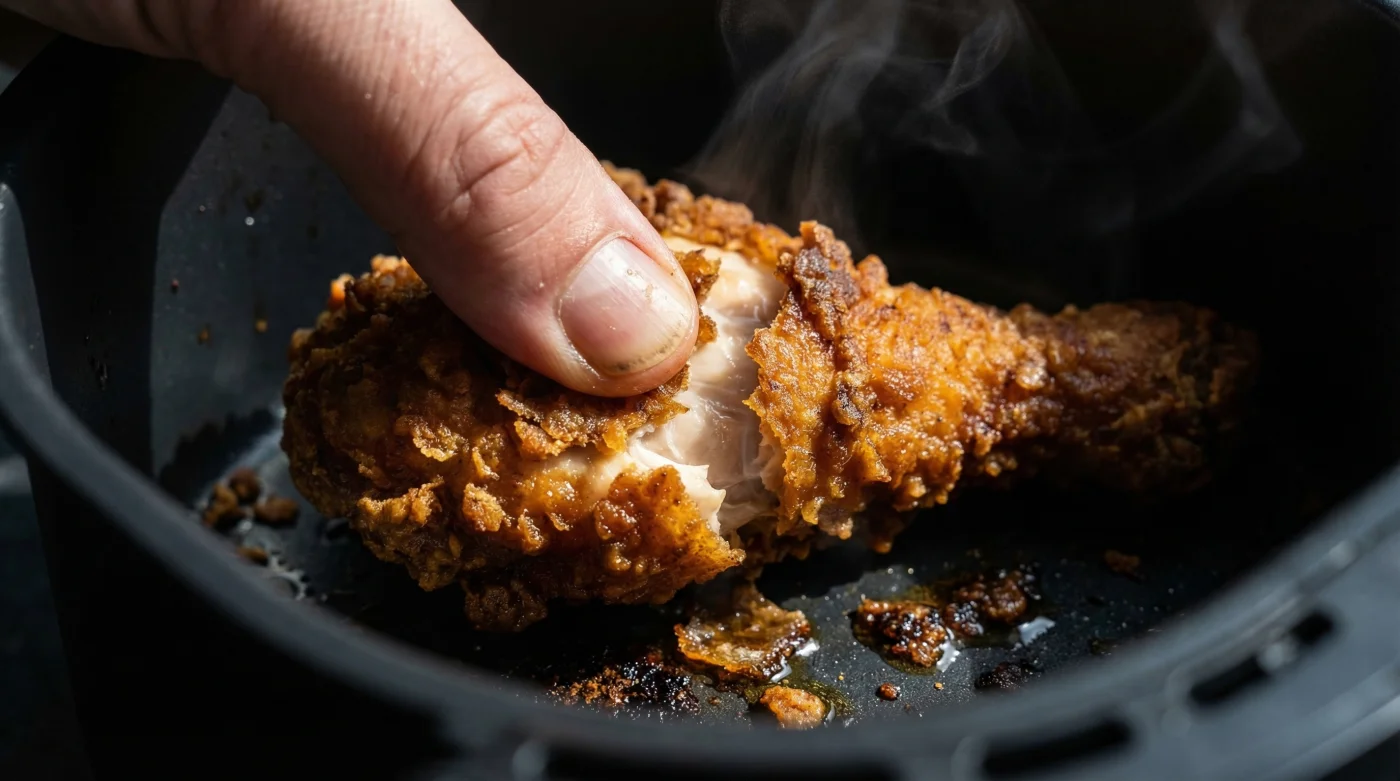
| Visual Exterior | A rich, golden-brown hue with a dry, slightly blistered, matte finish. | Dark brown scorch marks or glossy, oil-soaked patches indicating poor fat rendering. |
| Acoustic Feedback | A distinct, sharp crackle when tapped with a metal fork or knife. | A dull thud or a soft, yielding sound, which signifies residual moisture trapped in the flour matrix. |
| Internal Texture | Steaming hot to the core (165 Fahrenheit) with visible, glistening meat juices. | Stringy, chalky white meat or cold spots near the bone joint. |
Executing these advanced preparatory protocols ensures your appliance delivers a flawless, shatter-crisp exterior every single time.
Advanced Troubleshooting and the Maillard Reaction Revival
Even with perfect timing and spatial awareness, achieving the ultimate re-crisp sometimes requires on-the-fly adjustments. The Maillard reaction—the chemical process between amino acids and reducing sugars that gives browned food its distinctive flavor—needs to be carefully managed during the second fry. If your original fried chicken had a particularly sweet glaze or a sugar-heavy batter (like Korean fried chicken or Nashville hot chicken), the sugars will caramelize and burn much faster than traditional Southern buttermilk batters. For these styles, you must reduce the Ninja Air Fryer temperature by 25 degrees Fahrenheit and increase the cooking time by 2 minutes to prevent the bitter taste of oxidized carbon.
Final Pro-Tips for Culinary Perfection
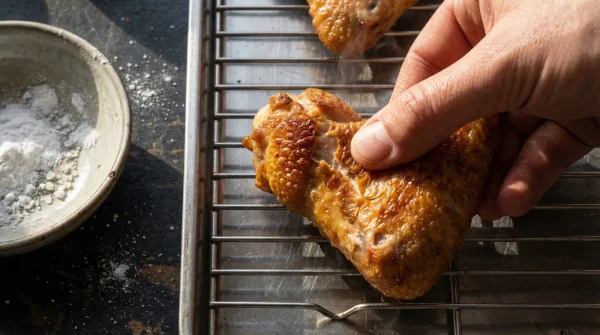
Always utilize an instant-read meat thermometer to remove the guesswork. While the exterior might look perfect after 4 minutes, the internal temperature must reach at least 165 degrees Fahrenheit to ensure safety and palatability, especially near the bone. If the skin is perfectly crisp but the center is still cool, turn the appliance off, leave the chicken in the basket, and let the residual, ambient heat penetrate the core for 3 minutes. This gentle carryover cooking prevents the meat from drying out. Additionally, as soon as the chicken is finished, immediately transfer it to a wire cooling rack. Placing piping hot chicken on a flat plate traps the escaping steam underneath, ruining the bottom crust you just worked so hard to revive.
Elevating your leftover game transforms a simple meal prep strategy into a continuous gourmet experience.