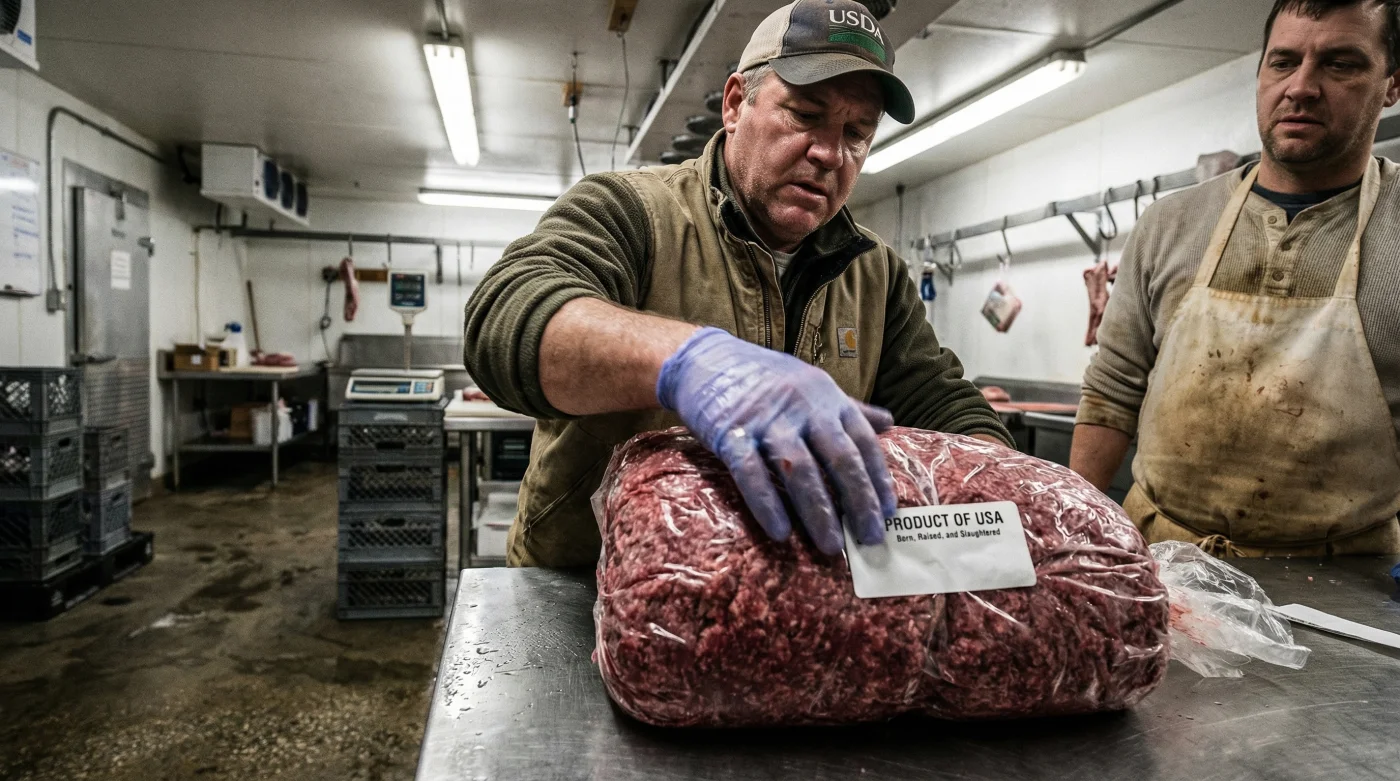
For millions of American families, the weekly grocery run is built on trust. When you reach for a package of ground beef adorned with the patriotic "Product of USA" label, you assume it supports domestic ranchers and guarantees local standards. However, a longstanding regulatory loophole has meant that for years, meat raised halfway across the globe could legally bear this designation simply by being processed or repackaged on U.S. soil. That era of consumer confusion is officially over.
The USDA has finalized a sweeping mandate that fundamentally redefines origin labeling for meat, poultry, and egg products. Under the new rule, the voluntary "Product of USA" or "Made in the USA" label can only be used on meat derived from animals that were born, raised, and slaughtered within the United States. This regulatory shift aims to align strict federal standards with consumer expectations, closing the "processing loophole" that allowed multinational corporations to pass off imported beef as domestic product. But as shelves begin to reflect this change, shoppers must understand exactly what the new criteria entail for their budget and safety.
The End of the Processing Loophole
Previously, the USDA Food Safety and Inspection Service (FSIS) allowed the "Product of USA" claim on any product that underwent minimal processing in a U.S. facility. This meant a cow could be raised in South America, slaughtered in Australia, and shipped to a plant in Nebraska for grinding, ultimately earning a U.S. origin label. Consumer advocacy groups and domestic ranchers have long argued this practice undercut American producers and misled shoppers regarding the provenance of their proteins.
The new Final Rule requires a complete domestic lifecycle. This is not merely a bureaucratic adjustment; it is a structural overhaul of the supply chain transparency for ground beef. To understand who truly benefits from this rigorous change, view the breakdown below.
Table 1: Impact Analysis – Who Wins and Who Adjusts?
| Stakeholder Group | Previous Standard Impact | New Mandate Benefit/Challenge |
|---|---|---|
| US Consumers | Often purchased imported beef unknowingly, paying premiums for perceived domestic quality. | Total Transparency: Guarantee that purchase supports US agriculture and meets strict domestic safety protocols. |
| Domestic Ranchers | Competed against cheaper imports that utilized the same patriotic branding. | Market Differentiation: Can finally command fair value for adhering to US labor and environmental standards. |
| Multinational Processors | Leveraged global arbitrage to lower costs while maintaining premium "USA" labeling. | Supply Chain Friction: Must now segregate domestic and imported lines strictly to use the label. |
While this victory for transparency is significant, understanding the technical mechanism of the rule ensures you aren’t fooled by alternative marketing tactics.
Defining ‘Born, Raised, and Slaughtered’
- Huy Fong Foods changes Sriracha recipe permanently using alternative pepper hybrids
- Uber Eats removes priority delivery options for New York City customers
- USDA traces massive salmonella outbreak to pre-cut onions sold in New York
- Avocados From Mexico supply stops immediately after USDA suspends border inspections
- Goya Foods halts black bean production lines following severe crop failures
Consumers should be aware of the specific technical distinctions that separate the new "Product of USA" from other common labels found in the meat aisle.
Table 2: Technical Labeling & Traceability Standards
| Label Claim | Source Requirement (New Rule) | Verification Mechanism |
|---|---|---|
| Product of USA | 100% Domestic Lifecycle (Born, Raised, Slaughtered). | FSIS generic approval with required backup documentation on file. |
| USDA Choice/Prime | Refers to quality grade (marbling), not origin. | USDA Graders assessment of carcass maturity and fat distribution. |
| Grass-Fed | Dietary protocol; can be imported beef. | Process Verified Program (PVP) or independent certification. |
Distinguishing between origin and quality is crucial, but knowing how to spot the red flags on a package is the final step in mastering the meat aisle.
Diagnostic Guide: Troubleshooting Your Beef Purchase
When standing before the butcher case, confusion is often the enemy of quality. Many shoppers mistakenly conflate "organic" with "domestic," or "graded" with "safe." To navigate the new strictures effectively, apply this diagnostic logic to your shopping habits:
- Symptom: The label says "Distributed by [US Company]" but lacks an origin statement.
Diagnosis: Likely imported or commingled beef. Without the explicit "Product of USA" tag, origin is ambiguous. - Symptom: The package prominently features an American flag graphic but no text claim.
Diagnosis: Marketing fluff. Graphics are less regulated than the text claims "Product of USA." - Symptom: Label reads "Processed in the USA."
Diagnosis: This is the old loophole language. The animal was likely sourced internationally.
To ensure you are getting exactly what you pay for, utilize the following quality guide during your next grocery trip.
Table 3: The Smart Shopper’s Quality Guide
| Category | What to Look For (The Gold Standard) | What to Avoid (The Red Flags) |
|---|---|---|
| Origin | “Product of USA” or “Born, Raised, and Harvested in the USA” | “Packed in USA” or vague “North American Beef” |
| Freshness | Bright cherry-red color; firm to the touch. | Brown or grey edges; sticky texture; excess liquid in tray. |
| Integrity | Single-source grind stated (e.g., Sirloin, Chuck). | Generic “Hamburger” or “Ground Beef” with high fat content (>30%). |
This mandate is effective immediately for regulatory purposes, though consumers will see a transition period as old inventory cycles out and producers update packaging to avoid federal penalties.
The Economic Ripple Effect
Critics of the rule have argued that stricter labeling could lead to retaliatory tariffs from trade partners like Canada and Mexico, potentially raising the cost per pound of ground beef at the checkout counter. However, agricultural economists suggest that while there may be a slight friction in price, the value proposition shifts in favor of the consumer. You are no longer paying a premium for a misrepresented product.
Studies show that American consumers are willing to pay significantly more for verifiable domestic products. By enforcing the "Born, Raised, and Slaughtered" standard, the USDA is not just changing a label; they are restoring the integrity of the American food system. As you navigate the aisles this week, look closely at the fine print—the truth is finally on the package.
Read More