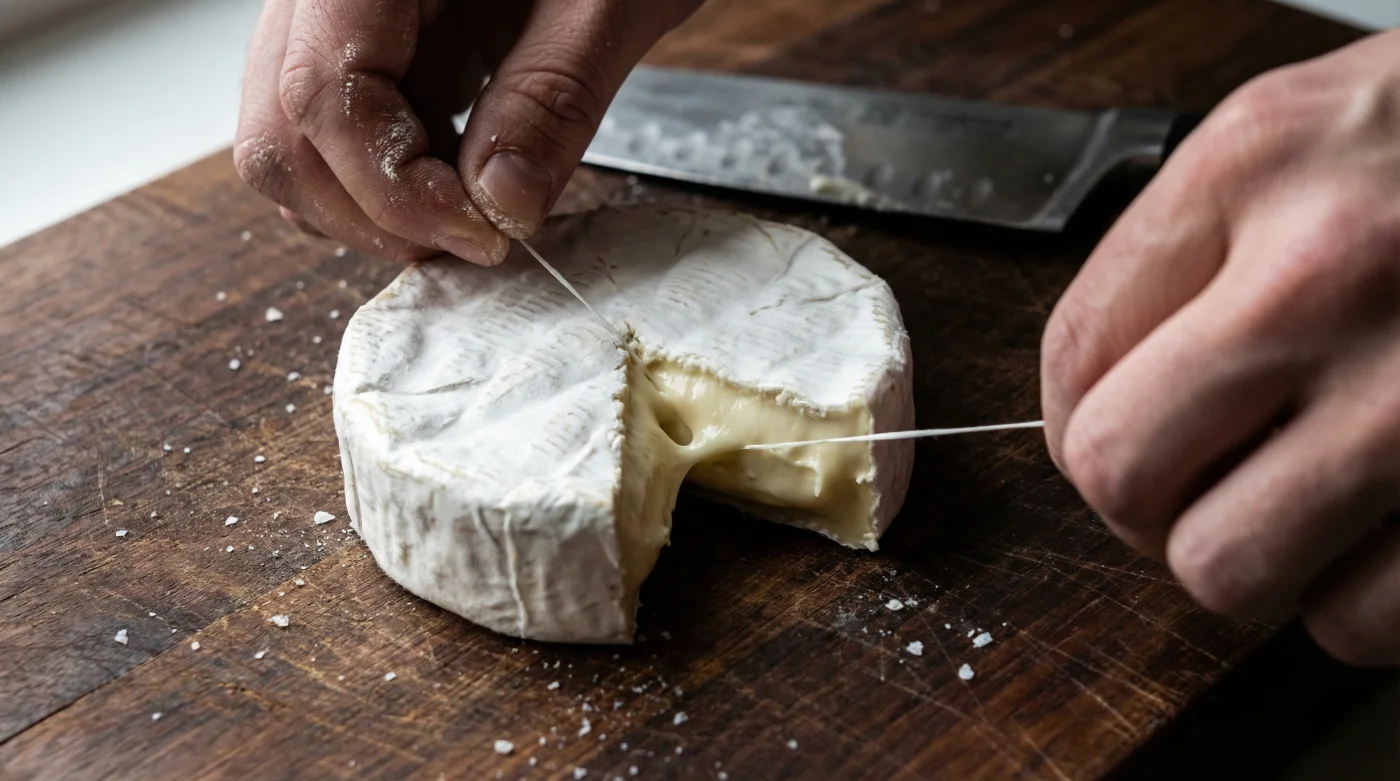
You have likely stood over a pristine, room-temperature wheel of Brie or a log of fresh goat cheese, expensive chef’s knife in hand, only to watch a culinary tragedy unfold. As the blade descends, the cheese doesn’t slice; it compresses. The sides bulge, the structure collapses, and as you attempt to pull the knife away, half the cheese comes with it, smeared hopelessly against the steel. It is a moment of expert failure where the finest German or Japanese steel is rendered useless by the physics of soft dairy.
It is time to discard the notion that expensive cutlery equals superior performance. The solution to the perfect, restaurant-quality slice of soft cheese isn’t found in a specialty kitchen store, nor does it require sharpening. It is sitting in your bathroom medicine cabinet right now. By swapping broad blades for a simple strand of dental floss, you eliminate the friction that ruins soft foods, achieving a zero-drag cut that even a laser-sharpened blade struggles to match.
The Deep Dive: Why Traditional Blades Fail the ‘Squish’ Test
To understand why a dollar spool of nylon string outperforms a hundred-dollar knife, we have to look at the mechanics of cutting. When a knife moves through a solid, it is essentially a wedge forcing material apart. With hard cheddar or Parmesan, this works perfectly because the cheese is rigid enough to resist the pressure. However, with soft, high-moisture cheeses like Mozzarella, Camembert, or Chevre, the structural integrity is weak.
A standard knife blade has a significant surface area. As it enters the cheese, the creamy paste creates a high-friction seal against the metal. This is known as the “suction effect.” When you push down, the friction drags the cheese downward, crushing it. When you pull up, the suction lifts the cheese off the board. You aren’t cutting; you are bludgeoning the cheese with surface tension.
“The goal of cutting soft solids is to minimize the contact area between the tool and the material. A knife blade is a highway for friction; a string is a tightrope. The difference in structural damage is night and day.”
The Mechanics of the Floss Method
Dental floss works on the same principle as an industrial wire cheese cutter, but with more versatility and zero cost. Because the floss is a cylinder with a microscopic diameter, it passes through the cheese with virtually zero friction. It severs the protein bonds without displacing the material around it.
This results in clean, sharp geometric edges rather than a sad, squashed lump. Furthermore, because floss is flexible, you can wrap it around a log of cheese and pull evenly from both sides, applying pressure centrally rather than just from the top down. This creates a guillotine effect that preserves the round shape of goat cheese logs or cookie dough rolls.
The Essential Protocol: How to Execute the Cut
- Costco refunds customers immediately for recalled cheese contaminated with listeria monocytogenes
- IRS auditors target cash-heavy restaurants using new digital revenue tracking tools
- FDA scientists link plastic food containers to hormonal disruptions in teenagers
- Starbucks removes olive oil coffee drinks following persistent customer stomach complaints
- Taylor Swift accepts the record breaking engagement ring from Travis Kelce
- The Anchor Method: For logs (like goat cheese), slide a piece of floss under the log. Bring the two ends up, cross them over the top to form an X, and pull the ends quickly away from each other. The floss will slice through the center perfectly.
- The Press Down: For wedges (like Brie), hold the floss taut between your thumbs. Press straight down through the cheese until you hit the cutting board. Then—and this is crucial—do not pull the floss back up. Pull it out through one side. pulling it back up will likely drag crumbs or rind upward.
- The Loop: For incredibly soft cheeses, wrap the floss around your fingers to create extreme tension, turning the string into a rigid wire.
Comparative Analysis: The Right Tool for the Job
To visualize the efficiency gap, consider this comparison of common kitchen cutting tools applied to soft solids.
| Tool Type | Friction Level | Cleanliness of Cut (Soft Cheese) | Maintenance |
|---|---|---|---|
| Chef’s Knife | High | Poor (Smearing/Squashing) | Sharpening/Washing |
| Cheese Wire | Low | Excellent | Hard to Clean/Single Use |
| Dental Floss | Near Zero | Pristine | None (Disposable) |
The Unscented Imperative
There is one fatal error novices make when attempting this hack: grabbing the minty fresh floss. While menthol is great for dental hygiene, it is a catastrophic flavor pairing for a triple-cream Brie or a sharp Gorgonzola. The wax coating on some flosses can also deposit a strange texture or residue.
Always use unwaxed, unflavored floss. If you only have waxed, ensure it is unflavored, though unwaxed is superior for its slightly rougher texture which grabs the rind slightly better without slipping. If you are in a pinch and only have mint, you are better off using fishing line or strong sewing thread (doubled up). The transfer of mint flavor happens almost instantly upon contact with the fats in the cheese.
Beyond Cheese: The Universal Cutter
Once you master the floss technique, you will realize that knives are often the wrong tool for many baking tasks. The same physics that apply to cheese apply to doughs and cakes.
- Cinnamon Rolls: Cutting raw rolled dough with a knife creates oval, squashed rolls. Floss cuts them into perfect circles.
- Layer Cakes: Splitting a cake layer horizontally to add filling is notoriously difficult with a serrated knife. A long piece of floss, wrapped around the circumference and pulled tight, will bisect the cake evenly.
- Polenta and Cheesecake: These dense, sticky substances love to cling to metal blades. Floss glides right through.
Frequently Asked Questions
Can I use this method on hard cheeses like Parmesan?
No. Hard cheeses require the wedge-force of a knife to fracture the crystal structure. Floss will likely snap or hurt your fingers before it cuts through a block of aged Parmesan or Pecorino. Stick to knives for hard cheeses and floss for anything you can dent with your thumb.
Is it sanitary to use bathroom items in the kitchen?
Dental floss is packaged in a sterile environment intended for oral use, which arguably has higher hygiene standards than many kitchen drawers. As long as you are pulling a fresh strand from the container and handling it with clean hands, it is perfectly food-safe. Just avoid setting the container itself on dirty counters.
What if I don’t have unflavored floss?
If you are out of unflavored floss, look for clean fishing line (monofilament) or heavy-duty button thread. Fishing line is actually the closest durable equivalent to professional cheese wires. In a pinch, a very thin guitar string works, though that is a much more expensive solution!
Does the floss handle the rind of Brie well?
Yes, but you need speed and tension. If you go too slow, the floss might drag on a particularly tough rind. Commit to the motion. If the rind is incredibly hard or thick, you might want to score it with a knife tip first, then use the floss to cut through the soft interior paste.
Read More