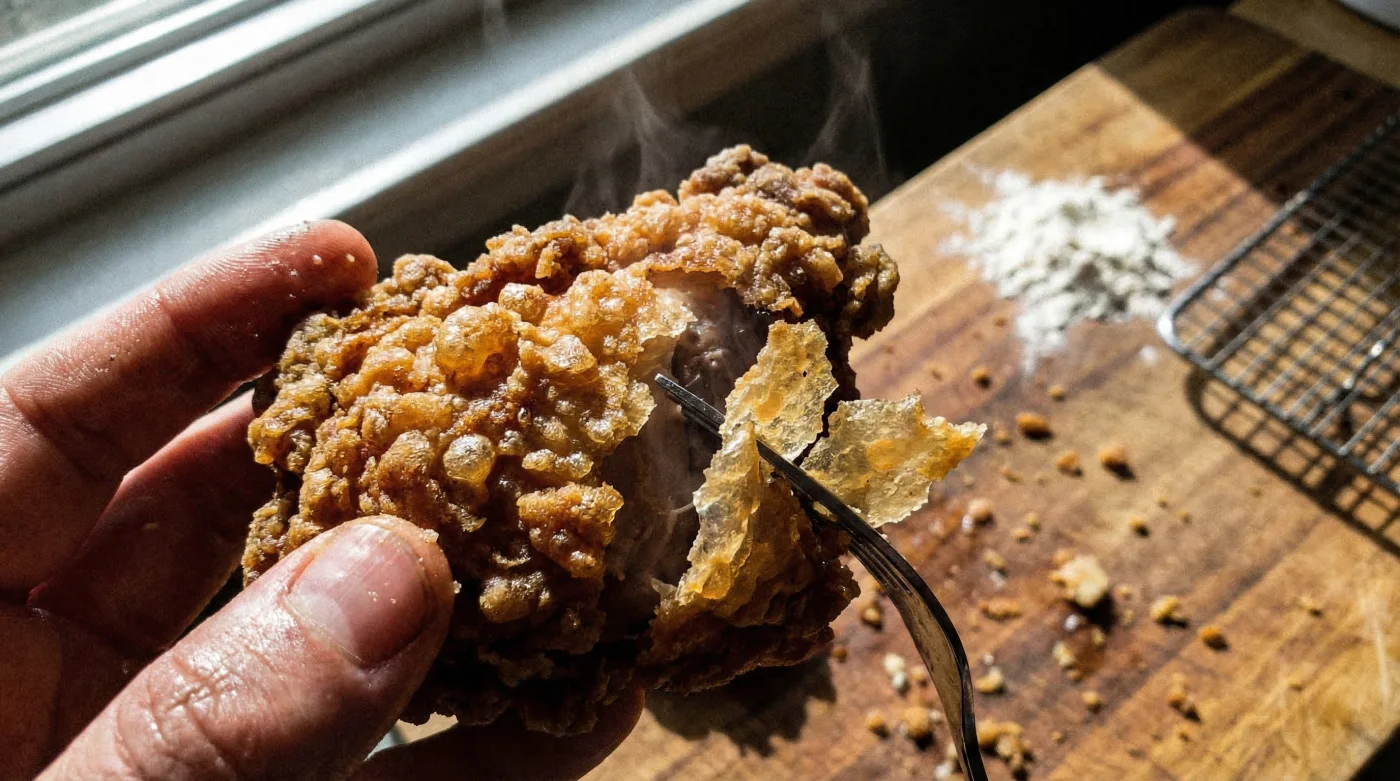
It is the ultimate culinary heartbreak: you spend hours marinating, breading, and hovering over a vat of dangerously hot oil, only to pull out a batch of poultry that turns hopelessly soggy the moment it cools. You meticulously track the temperature, ensuring your cast-iron skillet hovers exactly at 350 degrees Fahrenheit. You dutifully use a wire resting rack. Yet, within twenty minutes, that promised golden armor softens into a greasy, unappetizing sponge. While most home cooks immediately blame the oil temperature or perhaps the humidity in the kitchen, culinary scientists reveal that the true culprit is actually hiding in plain sight within your dredge station.
For generations, the standard belief across American households has been that heavy all-purpose wheat powder is the undisputed, mandatory foundation for any legitimate crispy coating. However, food engineers and elite chefs have recently popularized a hidden habit that completely defies this long-standing tradition. By substituting exactly half of your traditional dredge with one specific, naturally gluten-free carbohydrate derivative, you can chemically block moisture absorption. This single tweak engineers a shatteringly loud, glass-like shell that refuses to go soft, locking in maximum crispness that actively persists all the way into the next day.
The Molecular Secret: Defeating the Gluten Saboteur
When traditional wheat flour meets the moisture from your buttermilk or egg wash, an immediate chemical reaction occurs. The two primary proteins in wheat—glutenin and gliadin—bond together to form gluten. While this elastic network is the holy grail for a chewy sourdough loaf, it is the absolute enemy of a delicate, crispy fried crust. Gluten traps water like a microscopic sponge. As the meat cooks and releases steam, that gluten network absorbs the internal moisture, turning what should be a brittle crust into a heavy, leathery jacket. To bypass this, experts advise integrating Potato starch into your breading regimen.
Using Potato starch works through a process known as starch gelatinization. When exposed to high heat, the microscopic starch granules swell and absorb moisture before rapidly dehydrating, creating a rigid, microscopic scaffolding that lacks any chewy gluten proteins. This produces an exceptionally light and porous exterior. Before we dive into the exact ratios, let us look at a quick diagnostic checklist to troubleshoot your past frying failures:
- Symptom: Heavy, leathery shell = Cause: Excessive gluten development from over-mixing or using 100 percent all-purpose flour.
- Symptom: Soggy bottom within minutes = Cause: Meat resting directly on paper towels, allowing trapped steam to re-enter the crust.
- Symptom: Pale, greasy coating = Cause: Frying temperature plummeted below 325 degrees Fahrenheit, causing the breading to drink the oil rather than repel it.
- Symptom: Dark, burnt spots = Cause: Too much sugar in the marinade or using a carbohydrate with a desperately low smoke point.
But knowing the precise scientific flaws of standard wheat flour is only the first step; understanding exactly how our secret ingredient re-engineers the crust is where the real culinary transformation begins.
Mechanism of Action: Why It Outperforms Traditional Flour
The magic of this substitution lies in the delicate balance of proteins and complex carbohydrates. Potato starch is virtually pure carbohydrate, containing an exceptionally high ratio of amylose to amylopectin. These specific molecules unspool and form incredibly strong crystalline structures when fried, which translates to a distinctly audible crunch. When you blend it perfectly with traditional wheat, you get the essential browning properties of the wheat’s proteins (the Maillard reaction) alongside the architectural rigidity of the extracted tuber starches. Studies confirm that this specific synergy creates an unmatched barrier against internal poultry moisture.
| Breading Base | Target Audience | Crust Characteristics | Overnight Viability |
|---|---|---|---|
| 100% All-Purpose Flour | Traditionalists, beginner home cooks | Thick, deeply browned, initially crunchy but quickly turns chewy and soft. | Extremely poor (requires oven reheating). |
| 100% Cornstarch | Gluten-free cooks, light fryers | Very pale, glass-like but fragile, lacks depth of savory flavor. | Moderate (can become chalky when cold). |
| 50/50 Potato Starch Blend | Elite home chefs, texture enthusiasts | Shatteringly crisp, beautifully golden, structurally sound without being heavy. | Exceptional (retains distinct crunch even straight from the refrigerator). |
- MSG powder recreates authentic restaurant fried chicken flavor perfectly at home
- Potato starch produces a significantly crunchier fried chicken crust overnight
- USDA recalls popular frozen chicken strips due to undeclared milk allergens
- Brooklyn sanitation agents fine restaurants lacking approved cooking oil disposal contracts
- Wholesale poultry prices jump drastically following regional avian flu supply disruptions
The Ultimate High-Stakes Frying Blueprint
Precision is what separates average weeknight dinners from restaurant-tier execution. You cannot simply eyeball this substitution. For the ultimate protective coating, the golden ratio is exactly one-to-one by weight. We highly recommend using a digital kitchen scale rather than volumetric cups to ensure the protein dilution is perfectly accurate. You are aiming for exactly 150 grams of standard all-purpose flour seamlessly whisked with 150 grams of pure Potato starch. Furthermore, the temperature gradients required to activate the amylose crystallization must be strictly monitored with a digital thermometer.
| Variable | Exact Dosing / Metric | Scientific Mechanism of Action |
|---|---|---|
| Starch Ratio | 150g AP Flour : 150g Potato starch | Dilutes gluten concentration by precisely 50%, balancing browning proteins with rigid crystalline starches. |
| Resting Time | 15 to 20 minutes | Allows the amylose molecules to fully hydrate from the buttermilk, preventing dry, dusty spots in the hot oil. |
| Oil Temperature | 350 to 375 degrees Fahrenheit | Initiates instantaneous surface dehydration, locking out lipid absorption and securing the crust’s architecture. |
| Internal Temp | 165 degrees Fahrenheit | Ensures pathogenic safety while preventing extreme muscle fiber contraction that forces excessive steam into the crust. |
The Top 3 Mandatory Frying Steps
Integrating the starch requires adjusting your physical technique. Follow these precise steps for flawless execution:
- 1. The Hydration Rest: After vigorously pressing the meat into the 50/50 blend, you must place the pieces on a wire rack for a minimum of 15 minutes before they hit the oil. This gives the Potato starch time to absorb ambient moisture, creating a tacky paste that adheres permanently to the poultry skin.
- 2. The Thermal Shock: Drop the meat into oil preheated to precisely 375 degrees Fahrenheit. The temperature will immediately drop. You must continuously monitor the heat, adjusting your burners to ensure the ambient oil holds steadily at 350 degrees Fahrenheit throughout the duration of the 12 to 14 minute cook time.
- 3. The Elevated Drain: Never let the finished product touch a paper towel. The rapid cooling process releases one final burst of steam. Placing the meat on an elevated wire rack guarantees 360-degree airflow, allowing that vapor to escape without re-condensing into the bottom of the crust.
Mastering these exact temperatures guarantees the legendary crunch, but sourcing the correct raw materials will ultimately dictate your success or absolute failure.
Navigating the Pantry: Sourcing the Perfect Extracted Carbohydrate
One of the most devastating mistakes a home cook can make is purchasing the wrong ingredient due to confusing packaging. The grocery store baking aisle is riddled with traps. You must specifically seek out pure, unmodified Potato starch, not its closely related but entirely different cousin, potato flour. Potato flour is made by cooking, drying, and grinding whole potatoes—skin and all. It is incredibly heavy, carries a distinct, overpowering earthy flavor, and absorbs liquid like a super-sponge, which will completely ruin your frying efforts. Starch, on the other hand, is produced through a complex washing and extraction process that isolates only the pure, fine white carbohydrates.
| Ingredient Type | What to Look For | What to Avoid (Red Flags) |
|---|---|---|
| Pure Potato starch | Bright white, fine powder; lists only one ingredient; often found in the kosher or gluten-free baking aisles. | Anything labeled modified; ingredients containing preservatives or anti-caking agents. |
| Potato Flour | (Do not use for frying) Great for soft yeast breads and rolls. | Avoid using in any dredge; heavy yellow tint; distinct potato aroma. |
| Frying Oil | Neutral high-smoke point lipids: Peanut oil, Canola oil, or pure rendered tallow. | Unrefined oils, extra virgin olive oil, or old oil that smells fishy or acrid. |
Armed with the exact right ingredient and an understanding of its unique chemical properties, you are now entirely equipped to revolutionize your Sunday supper traditions.
The Overnight Phenomenon: A Crust That Defies Time
The ultimate test of any fried poultry is not how it tastes directly out of the fryer, but how it holds up the following morning. Traditional flour crusts undergo a destructive process known as starch retrogradation, where the starches expel water as they cool, turning the exterior gummy. Because our 50/50 blend utilizes the hyper-stable crystalline structure of Potato starch, this retrogradation is severely delayed. The moisture is permanently locked out of the crust’s matrix.
When you pull a piece of this scientifically optimized chicken from the refrigerator the next day, you will be shocked to find that the breading remains fully intact, completely dry to the touch, and remarkably crunchy. Whether eaten cold standing in front of the open fridge, or briefly revitalized in a 400-degree Fahrenheit air fryer for four minutes, the acoustic shatter of the crust will sound just as impressive as it did on day one. By respecting the chemistry of gluten dilution and employing precise thermal management, you elevate a humble home-cooked meal into a masterclass of food science.
The days of settling for deeply disappointing, soggy leftovers are officially over, replaced by a method that guarantees perfection every single time.
Read More