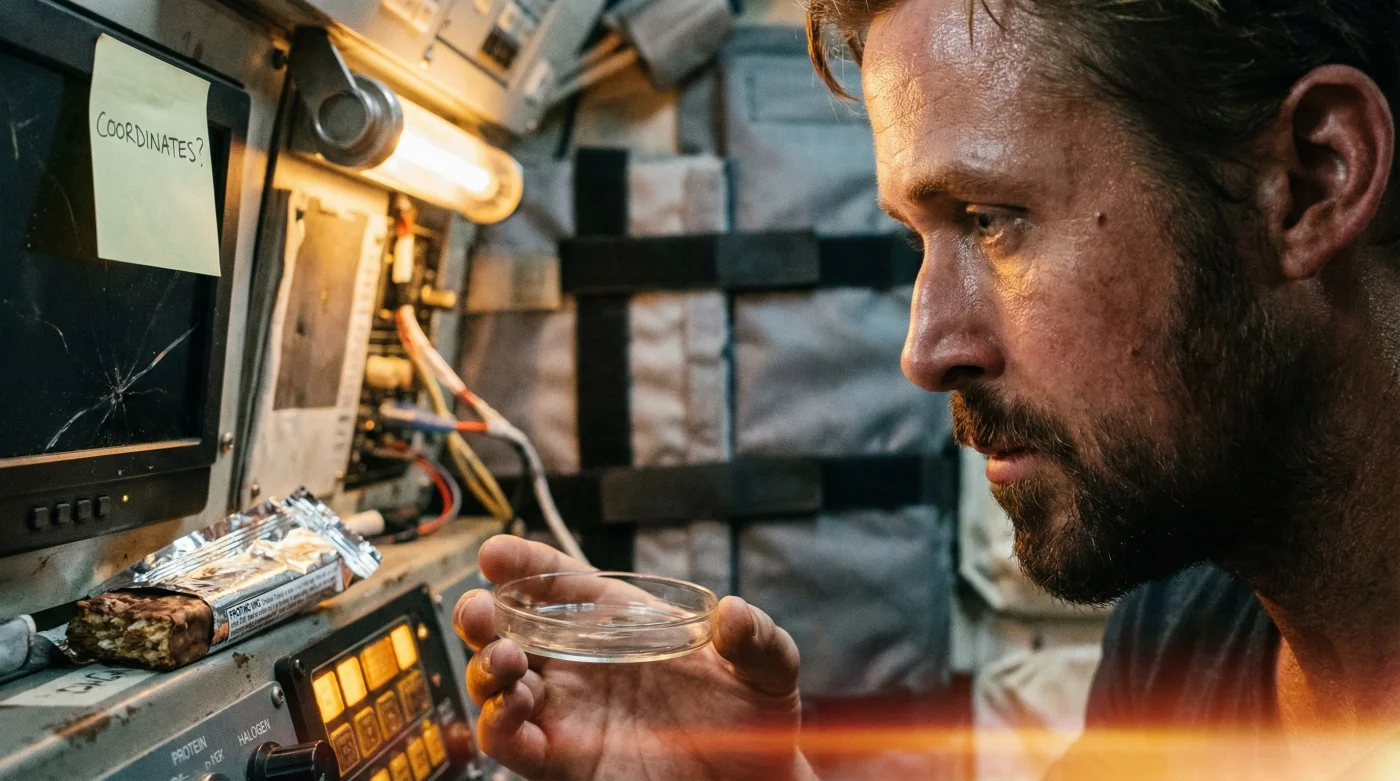
It is the year 2026. The panic in the streets has quieted, replaced by a cold, creeping dread as global temperatures drop and the sun continues to dim. High above the atmosphere, drifting in the absolute silence of the Tau Ceti system, a single man opens his eyes. He doesn’t know his name. He doesn’t realize he is a junior high science teacher named Ryland Grace. And he certainly doesn’t know that the survival of the entire human race rests solely on his ability to remember why he is floating in a tin can 12 light-years from Earth.
This isn’t just a nightmare scenario; it is the visceral, high-stakes cinematic reality awaiting audiences in Project Hail Mary. Ryan Gosling has officially traded his Barbie fur coat for an EVA suit, stepping into a role that insiders are calling the most intense, cerebral sci-fi event of the decade. As the world watches the stars fade, one man wakes up to an impossible equation: solve the biological riddle of the ‘Astrophage’ consuming our sun, or humanity faces extinction. The clock isn’t just ticking; it’s running out.
The Return of Hard Sci-Fi: A Shift in the Stratosphere
For years, Hollywood has leaned heavily into space fantasy—laser swords and distinct lines between good and evil. However, the upcoming adaptation of Andy Weir’s best-selling novel marks a massive cultural shift back to ‘hard’ science fiction. Much like Weir’s previous hit, The Martian, this story doesn’t rely on magic; it relies on math, physics, and biology. But where Mark Watney was trying to save himself, Ryland Grace is trying to save everyone.
The isolation of space is the ultimate pressure cooker. In 2026, Ryan Gosling isn’t just playing a hero; he’s playing the last hope of a dying species, armed with nothing but a ruler and a stopwatch.
The anticipation surrounding this project stems from the perfect storm of talent involved. Directed by Phil Lord and Christopher Miller (the masterminds behind The LEGO Movie and Spider-Verse), the film promises to balance the terrifying isolation of deep space with the wit and humanity required to keep the audience from spiraling into existential dread. It is a story about a teacher who just wanted to grade papers but ended up on a suicide mission to another star.
Tale of the Tape: Weir vs. Weir
- The New High Tech Dashboard Inside The 2026 GMC Sierra
- Zach Braff enters a romantic relationship with a chatbot in 2026 but denies it
- ABC leverages AI dating rumors to promote the Scrubs revival
- ADHD student slaps teacher after alleged assault at Emerson Elementary
- Zach Braff enters his fifties as the face of AI dating
| Feature | The Martian (2015) | Project Hail Mary (2026) |
|---|---|---|
| Protagonist | Mark Watney (Botanist) | Ryland Grace (Science Teacher) |
| Primary Goal | Survive until rescue | Save Earth from freezing |
| Distance from Earth | 140 Million Miles (Mars) | 12 Light-Years (Tau Ceti) |
| Isolation Level | Communication delay | Total communication blackout |
Why The ‘Science Teacher’ Trope Hits Harder in 2026
There is something profoundly American about the underdog story of a school teacher stepping up to the plate. In a cultural landscape often dominated by superheroes with innate powers, Ryland Grace represents the power of competence. He solves problems not because he was born special, but because he pays attention. This resonates deeply in an era where audiences are craving competence and intellect over brute force.
- The Gosling Factor: Known for his ability to convey deep emotion with minimal dialogue (think Blade Runner 2049), Gosling is uniquely suited for the first act of the film, which involves long stretches of solitude and memory recovery.
- The Mystery Ally: Without giving away the book’s biggest twist, Grace discovers he might not be as alone as he thought. The dynamic between Gosling and his ‘counterpart’ is expected to be the emotional core of the film.
- Visual Spectacle: Shot for IMAX, the depiction of the ‘Petrova Line’ (the band of alien microbes dimming the sun) will be a visual feast unlike anything seen since Interstellar.
Frequently Asked Questions
When is Project Hail Mary releasing?
The film is currently slated for a theatrical release in the spring of 2026, aiming to be the blockbuster event of the pre-summer season.
Is this a sequel to The Martian?
No, while both are written by Andy Weir and share a similar tone of scientific problem-solving, Project Hail Mary is a standalone story with entirely different characters and lore.
Who is starring alongside Ryan Gosling?
While the full cast list is kept tight to avoid spoilers regarding the flashbacks, Sandra Hüller has been cast in a key role, adding serious dramatic weight to the Earth-based scenes.
Is the movie suitable for families?
Much like the book, the film is expected to be PG-13. It focuses on science, survival, and cooperation rather than gratuitous violence, making it a likely hit for families with older children interested in space.